Tuesday, 30 September 2014

Meghalaya Memories #Part 2

Many a times a trip does not turn out to be what one had initially planned. Thus the second post on the Meghalaya journey by my aunt turned out to be more thrilling. With a Bandh on the list it seemed quite an adventurous position to be in , in terms of making a decision as to stay or leave. Read on to know what they exactly did throughout the second phase of their trip in this lovely land. Here it must be mentioned that due to lack of photographs all of them were taken from various sources from the internet and yes I do not run into Copyright violations.

Man proposes God disposes. That's what my father used to say. Early next morning as we went to have our breakfast, there were rumors that there might be a bandh the very same day. Nevertheless we decided to carry on with our sightseeing plans even if it was for just half a day.


GIRLS WEARING MEKHLA

So we went to the marketplace first & it turned out to be quite disappointing. It was drizzling and we could not find anything. The women were wearing Mekhla, the traditional skirt, sometimes with a light velvet stole and T-shirt instead of traditional Dupatta and blouse. They were also wearing a wrap around dress. A few elderly ladies were wearing it traditionally and in hand woven fabric. The younger girls wore it like a long frock or evening dress in synthetic or chiffon material. We did try to speak to some of the local girls, though most of them were reluctant and shy to speak to us.

We gave up shopping soon after and went to see the Elephant falls .The falls is named such because of the structure - it is a three layered structure which has resemblance with  an elephant trunk. The falls itself is magnificent and the powerful sound of water falling on the rocks, awe inspiring. Some of my friends wore the Khasi dress and posed for pictures.


VIEW FROM SHILLONG PEAK

Then we started for our last destination, the Shillong peak which offers an aerial view of the city. One can see the entire Shillong city from there. For the last time, we inhaled the breathtaking beauty of the State, the mysterious mountains, the pastel shades painted by the greatest artist of all times.


BUTTERFLY MUSEUM

HYDARI PARK
We did not have time for the Butterfly museum and Hydari Park. Perhaps we should have skipped the attempt at shopping in the morning but it was afternoon and we decided there was no point sticking around in uncertain condition of Bandh. 
 
MONGPU
We went back to hotel and made arrangements to climb down to Guwahati. The Shillong to Kolkata flights are not operational every day and the helicopter services were not available. We had to cross Mongpu where the Bandh was supposed to start by 6 pm. So, we had no other option but to make the return trip on the rental car at a supremely escalated rate. Locals informed that the Bandh might continue for more than a day. Staying back could have disrupted our future schedules.

We saw the Barapani nearer this time. The night fell before we could get down. The road curved dangerously but our driver was quite an expert. In about three hours, we reached Guwahati. We only had one stop for refreshments. In the evening dim, an unusual series of brightly lit liquor shops lined the roadside as we drew nearer to Guwahati. 

The hotel we now checked into was okay but not a great one. It was located in a very congested area of Guwahati. The rooms reeked of naphthalene but the group was tired and hungry. We had to compromise.

SILKALAYA

KAMAKSHYA TEMPLE

Next day, we had breakfast at the hotel and started for the airport. On the way, we stopped at Silkalaya and did some shopping for our near and dear ones, back home. We did not have time for Kamakshya temple but we drove by Brahmaputra glistening in the morning sun. Guwahati seemed like just another city with heavy population. Roads are lined with leading Indian brands and congested with heavy traffic.

The flight took off and it was the end of our journey. We discussed when and where we would go next - a common topic on all vacations. Sweet home, hot weather and routine life beckoned us.

 Himalayas still appear out of thin air, as I close my eyes...
...and then my heart with pleasure fills  ...and dances with the Seven Sisters...


Sunday, 21 September 2014

Meghalaya Memories # Part 1

Sometimes there are many things that we wish for but cannot achieve in life. For instance though I love travelling I too am restricted due to many reasons.But that doesn't stop me from listening to other people's tales about their voyages- good or bad. Thus, this time when I missed the opportunity to travel to Meghalaya with my aunt (due to exams) I was eagerly waiting for their tales and experiences. This is to be noted that the entire post is a guest post alongwith the photographs by my aunt Mrs. Urmila Majumdar who recently visited Meghalaya with her husband and her friends.

On a cloudy summer Kolkata morning, we set for the hills of Meghalaya, for a two days- three nights short trip, yearning for a cooler climate. Kolkata was burning like Troy and the hills promised a much needed relief. Kolkata to Guwahati is a short, less than 2 hours flight. Once we landed in the Guwahati airport, we had to speak to a cab counter for hiring a car, for our 6 member team. We were being charged much higher than expected but we could not see any other option. However once we came out of the airport, we found lines of similar cars in different sizes. It would be advisable for future travelers, to hire from outside, since there can be a scope for bargaining.

Soon the landscape of the city gave way to the red, rough face of rocks and lush green foliage. In half an hour we took a meandering mountain road, climbing towards the city of Shillong. As we climbed higher, the different ranges of Himalaya played hide and seek at every bend. The twists and turns came so frequently that it was better to capture them in memory than through lenses. Our team members soon gave up and I kept on clicking through the iPad, since it was easier to handle. The bends tended to be sharper, as we climbed higher and higher, we had to hang onto the car handles and sometimes to each other, to maintain balance.

ROADSIDE WATERFALL

The majestic beauty of Himalayas soon silenced us all, except the driver. He was going full force, enlightening us on the social situation of the Khasis, punctuating each sentence with a hearty, loud bout of laughter. It seems that the matriarchal Khasi women are very powerful than their counterparts. The driver went on to say that the men mostly work as shuttle drivers to and fro from hotels and airports and in the evenings they go out with bullets. "Bullets!" I was all ears now. Is he talking about guns? Not yet it seems. Bullets are bikes. It seems bikers go out in the evening to have a good time. Then our driver spoke a little about his personal life, that he is working to get his sister married and may be then he can go to the "jungles".

We were hungry, so we stopped at a Dhaba. My energetic friends climbed the steep stairs of the road side restaurant and vanished inside to collect some food, while my husband and I waited at the car. The driver turned on some local music channel. The tunes were catchy and a few words of the local language resembled our mother tongue. Our friends came back with aloo paratha, chana and the food tasted divine, since it was late afternoon and we were ravenous. The serpentine path continued up and up and the weather cooled down. We devoured the food, continuing on the roller coaster ride, trying not to spill any gravy on each other.

We arrived at a picturesque location, Bara Pani. Here, let me divulge that this is my second visit in this area; the first one was when I was five. I heard from my mother that on the earlier trip, we had picnic on the banks of Bara Pani, so I had requested the driver to take us near it, en route to Shillong. The driver said we cannot go near, since it would be a total detour but he will get us a glimpse. I had read on the internet that it falls on the way, but did not wish to argue with him. We were already a little tired with his chatter and crazily continuous laughter. 


BARA PANI

The view of Bara Pani was breathtaking. Little wafts of candy floss clouds floated over the vast expanse of water below, surrounded by greenery and layers of mountain ranges. It was magical. Our awe was shattered by the sound of some returning vehicles on the other side of the road. Looking at five ladies at the spot, volume of the latest Hindi racy numbers went high. I dragged the team to the car and the journey continued. 

Soon we entered the city of Shillong. It was not like how I remembered Shillong from my childhood - the beautiful wooden houses and the gardens of paradise; fragrance of wild roses blooming in fetching disarray. Now, the houses were mostly dilapidated but quite a number of them had a well tended garden in the front. Roses, Dalia, Lilly, Gladioli and some unknown flowers bloomed in myriad hues. The shops in between the houses were ill kept. However, the Himalayas guarded and veiled all with its splendid, countless shades of green cloak. It was monsoon and the hills had come alive. Amidst such beauties we lost track of time and before we knew it, we had arrived at our hotel.

The next day was quite pleasant. Satisfied with a hearty breakfast, all climbed onto the Toyota Innova for our day's journey. We were on our way to Cherrapunji. The place holds the highest rainfall record in the world .It was not raining heavily but every now and then there was a very brief, light shower. It was so light that even an umbrella was redundant. 

We left the city and once again took the winding road with deep gorges on one side and steep mountain ranges on the other. The sky was a candy-floss carnival, gigantic clouds embracing medium and smaller baby clouds. Thin georgette veils of clouds drifted on our way. The name of the state, Meghalaya, is justified. As the car moved through the zigzag road, the sun played hide and seek and the tall mountain trees painted a poetic silhouette against the white clouds and the grayish blue sky. 

                   “I wandered lonely as a cloud
                                That floats on high o'er vales and hills”

We stopped on the way, to take some pictures. It seemed to be standard tourist take- a-photo point. Though tea baskets were kept for trash collection, it seemed people preferred the roadsides more for the purpose.
ECHO POINT

Next, we started for the Echo Park. It's a partly natural and partly created park. Thankfully the natural beauty-the spring flowing through the park and falling at great depth below in hurricane force, was undisturbed. Beyond the boundary of railings, lay Bangladesh offering a picturesque view. In my mind I greeted my father's land where I have never been.

NOH KA LIKAI FALLS

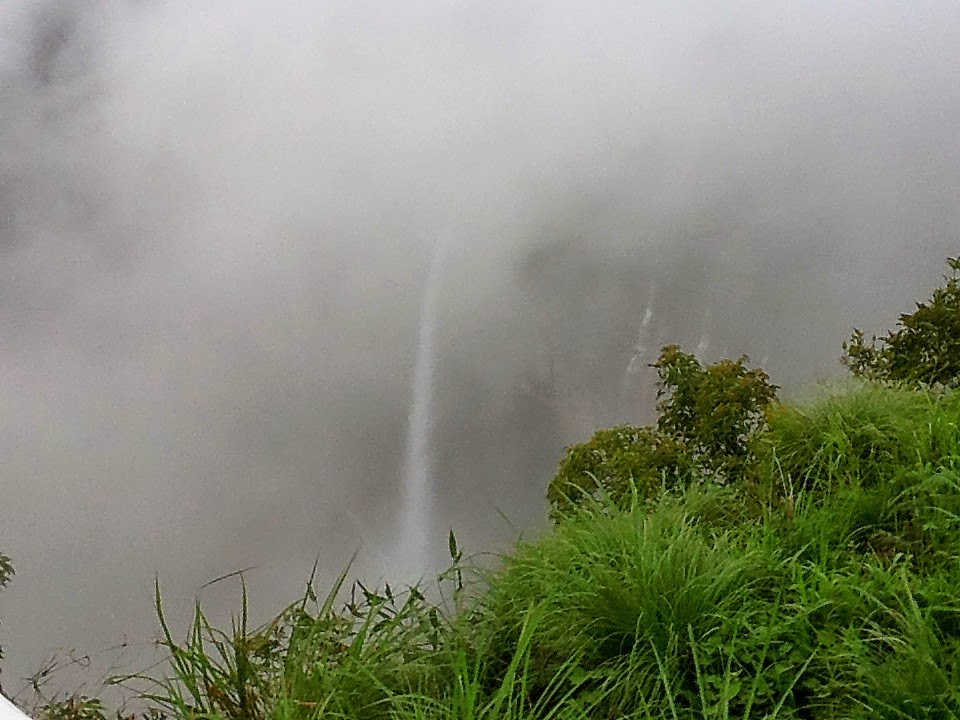
Next stop was the Noh Ka Likai falls. I will refrain from telling the entire story behind the name, but it involved a suicide. Most of the falls in Shillong seemed suicide points and has associated stories. The falls itself have great heights but are a slim beauty. Mists surrounded this one, like a white translucent chiffon sari.


SEVEN SISTERS FALLS 

We were hungry with all the walking around in the park and wanted to have lunch. Our next destination was the nice round shaped, Polo Orchid restaurant just beside the Seven Sisters falls. We sat in the restaurant chatting and praying the clouds would move to reveal the lively sisters and soon they appeared. For the entire duration of time we sat there and had the delicious food, the sisters were appearing and disappearing like a fine magician's assistants. They seemed more than seven, merrily dancing and sliding down the rough edges of the mountain, without a care for the onlookers, happy in their own company. I could have lived there forever, in a small log house perched on a mountain top, looking at the playful family.


COAL MINE
Time was passing and we did not wish to be caught in the mountain roads, so with an unwilling heart, we started our journey to the next destination - the limestone caves. On the way, we were shown the entrance of a coal mine. Inside it was dark, with slippery stones and bats hanging.

 We decided to take a look at the Ward’s Lake. It was just a man made place, with millions of tourists taking boat rides, chatting, posing for pictures. Interestingly, most of the attendants in the park were women. They were wearing traditional dresses & velvet stoles & collected money for the cameras.

It was getting late and soon we left the park and entered the hotel.
Mountains, unlike seas, are silent after sunset and each day holds something new. . . . . . . . . . 


Sunday, 14 September 2014

A (Photo) Walk to Remember

Photowalk is the new trend in the city for all the amateur photographers although I consider myself as a photo explorer. Why? I try to explore my camera too other than places that are perfect for pretty frames. That is exactly why on 13th September (which was thankfully not a Friday) I set out with my camera to the Bheris (fishing ponds) of Salt Lake. I believe, Photowalk, is not just about going to a place and capturing few good shots; it is more about knowing one’s city, its culture, and its serene beauty.

Reaching the bheri was an adventure in itself. From sneaking out early from college to listening to mom shouting about safety and finally braving the cloudy and rainy weather itself. With the main aim of shooting the sunset being washed away by rain, we decided to try our luck in shooting whatever was available.

The Bheri was right beside a row of IT Companies and also colleges and institutes. But even then, it was pleasant to see that amidst urbanization such a natural and peaceful place exists even today. The Bheris itself are surrounded by rows of small grasslands and an occasional tree here and there. Narrow roads dividing it make a pathway for people to cross over from the other side. Apart from the fishes that are bred there, the ecosystem also comprises little black ants, lots of crows, wild grasses and little flowers growing unevenly all over the place.


With the place being windy and cloudy due to the rain falling on the ground, it was difficult to focus and get a good shot. Although, luckily, there was a boat of fishermen which became the object of interest for quite some time and prone to many an experiments of mine.


Surprisingly, I made an attempt to shoot macro with a prime lens. This ultimately resulted in neck pain, hand pain and finally happiness when I could get my macro subject in full focus. This being my first attempt at macro requires more practice in the future and guidance to perfect this field.


The huge buildings of the IT offices and institutes which formed the background were also a subject that needed attention. In fact a wide shot would get in all the important elements of the place- the offices, the Bheris and the sky. It would be the perfect example of a place where urbanization, technology and development met nature.


However, the only fault with the place was that the same development was eating into the natural resources of the area. This not only causes environmental degradation but also reduces the natural beauty of the place.

On crossing the IT offices one can stand for hours in front of them and gauge at the huge infrastructures. Hearing noises coming from (what I thought might be) the canteen or the parking lot, one cannot do but wonder what type of work goes on inside, how are the people who worked there, how would the work culture be. Nevertheless, it might be impossible for me to get the answers to these questions as my career comes nowhere close to the IT sector.


Though, the main aim of capturing the sunset was not fulfilled, the trip was fruitful in many other ways. The adventure, the beauty of the open ponds, the macro subject, the dreams about IT offices and above all getting expert advice on shooting, all made the trip immensely successful for me.


Friday, 18 July 2014

The Decadence of Tradition

The City Of Joy has many hidden treasures which are rarely explored in the fever of modernism which has broken over the entire world. These traditional art forms are  famous only in rural Bengal. In fact this is the only method of survival and occupation , these families have been involved in for generations and thus till today their daily bread is earned through such art forms.Though many are found all over Bengal, I would be highlighting only five such decaying folk forms.

5# Chau Dance is a popular folk dance in Orissa , Jharkhand and West Bengal . Mostly seen in Purulia it is performed by the tribal communities of Munda, Bhol, Sahoo to name a few. This folk art has three different components - music provided by the Mukhis, Kalindis etc; masks made by ace artisans of the Sutradhar,Maharanas or the Mohapatra clan and the dancers. Chau dance itself has variations depending on its origin- Purulia chau, Mayurbhanj chau and Seraikella Chau. Interestingly Mayurbhanj chau is the only folk form which does not make use of any masks. The dance itself is a blend of martial arts and traditional dance steps.In 2010 Chau dance was honoured by UNESCO's Representative List of the Intangible cultural Heritage of Humanity. Special measures have been taken by the Government of Orissa to look into the preservation of this art form. But sadly in Bengal, it is a dying art.

CHAU MASK


CHAU DANCERS

4#  Bhawaiya is a traditional music form popular in Jalpaiguri, Cooch Behar, Darjeeling and North Bangladesh. These places came under the state of Kamtapur in older days . Hence, the Kamptapuri language is also used while singing the songs. The biggest performers of this art were those associated with the Rajbari of Kamtapur. However , today, these songs have spread to all communities living in the area. In fact many Bhawaiya songs have been adapted in Bengali cinema. The music in this folk form reflects a typical tone of natural, environmental, ethnic phonetic and topographical influence.

3#  Alkap is one of the primitive ways of mass communication. It was originally used to raise awareness regarding social issues and taboos. But today the original form of Alkap which included men dressing up as women, musicians singing songs and sexual connotations , is becoming extinct. It is replaced by Bengali film songs and women taking part in this form of performing art. The participants are divided to put forward arguments in support and against the social cause to communicate it to the people. However due to lack of interest and finance this art is rarely seen today.
ALKAP IN PROGRESS

2#  Gombhira which originated in the Nawabganj region is a another folk form of increasing social awareness through music and songs. It is distinct as it is performed by two males playing the role of a son and his maternal grandfather . Sometimes this art is also accompanied by masked dancers who enact the verses in the song.

MASKED DANCERS

GETTING READY FOR A PERFORMANCE

1#  Bhatiali are traditional boat songs which fishermen and boatmen sing while they are on their journey in the river. Bhatiali mostly deals with descriptions of Nature from those who are living in close harmony with nature. Influence of this form of music is found on the ghats of Brahmaputra in West Bengal and Bangladesh.

PAINTING OF BHATIALI SINGERS

These forms of art are becoming rare and extinct in contemporary times . Probably the instruments and technologies of modernism is to be blamed for this. With people remaining glued to television and cell phones, they neither have the time nor the interest to spare a thought about traditional art. There are a few heritage fairs in the city where performers from all parts of the State come in to showcase their talents; however, they have less audience and also the number of traditional groups that come in are decreasing year after year.The good news is many theatre groups, NGOs and private organisations are trying to revive these traditional art forms. It is a venture which I personally support and encourage everyone to support for tradition is a guide for a better future.


Friday, 11 July 2014

A Calcutta That Was. .

                                     “Nothing is ever really lost to us as long as we                                                                                             remember it.” 
                                                                                                    ― L.M. Montgomery, The Story Girl

I begin today's post with such a quote as it is specially connected to what this post is going to be about. Today I write about memories forgotten by many and unknown to many . Kolkata as we now know it , which is home to many of us has turned so modern that many cannot visualize what Calcutta was like. Though I do find some remains of old Calcutta here and there and mostly in North Calcutta, much of what was, is lost to us. The buildings demolished, the mansions brought down to make multi-storey buildings and above all the people who knew the past are fading away quietly  burying with them the many secrets of Calcutta.


Unfortunately I myself have not ever had a chance to communicate with such people but the good point is that these scenes are captured by great artists in their works. These works would never die and remind us of our culture and heritage whenever we forget it . I still remember during one of my college breaks when I entered a famous bookstore in Park Street and while my friends were looking at books I was staring at some paintings of Old Calcutta. A  young man called for an attendant  and asked him about the paintings to which the attendant looked clueless. In fact he replied that no one ever buys those and they just lie there year after year gathering dust. I was amazed by the reply which the young man gave and that reply is one of the primary reasons I am writing this post today he said and I quote" I am most unfortunate to not have been able to see the beauty of Old Calcutta and I am just trying to discover and keep that fire alive in society". That day he stunned two people with his reply- the attendant and me as well.

Since then I have started my own research about paintings of Old Calcutta and I think it would be best that they tell their own stories rather than me describing them today. Though there are lots of copyright issues I have still managed to find some that will not put anyone in trouble.


Starting with the oldest, anyone who has ever read the history of Calcutta would know the Battle of Plassey.

This is a painting of one of the famous animal sports played during the Raaj. Armed men would be seated on top of elephants and begin their hunt to kill an animal. These were some of the atrocious animals sports played and I sometimes wonder whether they are one of the reasons that wildlife is becoming endangered and extinct today.


Up next two of the most renowned and famous temples of Kolkata- Dakhineshwar Temple (Above) and Kalighat (Below). Earlier one used to cross the Ganges on shared boats to reach the Dakhineshwar Temple but today the infrastructure is so developed that hardly one sees anyone coming there by boat. In fact the boats seen in the sketch of Kalighat are near extinct. If one is lucky one might get to see some of them parked at the Ganges Ghat.


If temples are found in Calcutta, churches are also no less. Considering that the British ruled over us for 200 years it is impossible that churches were not built. The Scottish Church (Above ) and St Peter's Church in Fort William (Below) are two of the oldest churches in Calcutta. However if one visits them today, one would not be able to imagine the difference between the paintings and reality.


These form three of my personal favorite paintings and sketches. The First painting (above) is a view of the Esplanade road from Chowringhee. Looking at the place today it is hard to imagine that horses roamed the very streets once.The next one (Middle) is a painting of Belvedere  House Alipore. Interestingly such old houses today are the hotspots of ghost stories . Whether these stories are true or just tales told by locals to scare away people for their own personal gains is yet to be discovered. The third (Below) , a pencil sketch of Victoria Memorial  by Samir Biswas would always remain etched in the minds of those who take one look at it.


Since this post deals with sketches and paintings it would not be fair if I do not add a painting of an art gallery. And lastly I end the post with two very popular traditional Bengali paintings. The first by Jamini Roy and the second depicting the famous Sindoor Khela during Durga Puja.


 Though much has changed today in terms of technology and infrastructure development, still I sense that “Sometimes. . . . the things I remember are more real than the things I see. ” 


Saturday, 5 July 2014

The Walls of Kolkata . . . And Beyond

 I was walking down the street randomly looking , searching for an idea for my blog when I saw the walls around me . Something very familiar greeted me which I have seen in many places- Golfgreen, Jadavpur, Park Street etc. -these were nothing but graffiti's.  Many support it and many think it as vandalism .Personally, I think they are a means to beautify the worn out walls and provide colors to the otherwise dull streets and walls.It was this interest in graffiti and a search regarding it which made me befriend a well known graffiti artist in Kolkata. Hereon, my friend will be known by the name of Srek as most of the graffiti writers work under pseudonyms. They write their pseudonyms on falls to earn recognition or else charges of vandalism can be put up against them. They can truly be called "ghost writers".

Srek and his team have made numerous trips to various different lanes and by lanes of Kolkata and have created visually appealing graffiti which are recognized by their signature marks"Zypher".


This particular piece has been made in Lake gardens.The multi-coloured filling inside the alphabets spell out "ZYPHER". Underneath the signs of the artists have been made so that their identity can be retained.


Both these are a replication of my friends name. One (above ) made in Picnic Garden while the other one (below ) made in Sudder street. Having visited these places myself I can truly vouch for the fact that these break the monotony of the same brown -grey coloured walls cracking from different places and transforming the dullness into a masterpiece.

If you think that graffiti can only be done on walls and streets then it is a wrong notion. It can be done just about anywhere - even a truck. This particular truck was parked for a short time and within that time the graffiti magic was worked on to it to make it  look colourful in a manner one could never have imagined. This is what my friend calls as  The Truck Bombing in Lake Gardens.

PHOTO COURTSEY: SOVAN RAY AND SREK
While the young kids have different kinds of bags like Barbie bags and cartoon sketched bags, people going to college or carrying laptop bags have a dull blackish one, and even if it is not black it is always a monotone. But this monotone was broken by Srek again by actually painting  the bags. Mobile phone covers are also customized by doing graffitis of common superheros or cartoon characters.


In fact the wind of graffiti has also caught in other places. Recently, Srek was invited for the Graffiti jam in Delhi. The next one was created there.


Graffiti is now going global. Not many people are actually into this and those who are in it know each other through Social Media. A lot of sticker trade also goes on between different countries like Germany, Portugal, Spain, India and other places. Srek was recently invited as a guest to judge the Graffiti event in St James school as well.


 I must say about an year ago when I wrote an article on him and his group, Graffiti was evolving. It was despised by many and accepted by many. Today a year later I see a transformation in the attitude of the people. Many from the older generation actually support these groups when they come and work their magic. The Graffiti warehouse is where they meet , jam and plan out further events (details of which will not be revealed here though! ). It is great to see the people accepting it and actually supporting and promoting it. It is even a greater pleasure to see more and more youngsters, all school- college goers and some professionals  come together for regular graffiti jams hosted in the city.

On this note I wish all my luck to Srek and his team and all those involved in Graffiti for their wonderful endeavour in keeping it alive in the upcoming years. I will also acknowledge him and his team for the photographs .I end this post with two favourites of mine. The first one made in World Wide Battle for graffiti  and the second which literally means "Something done with a bang" 
.